
Design URL Shortener
case study: URL shortener
我们来设计一个 URL shortener,类似 Bitly、TinyURL。
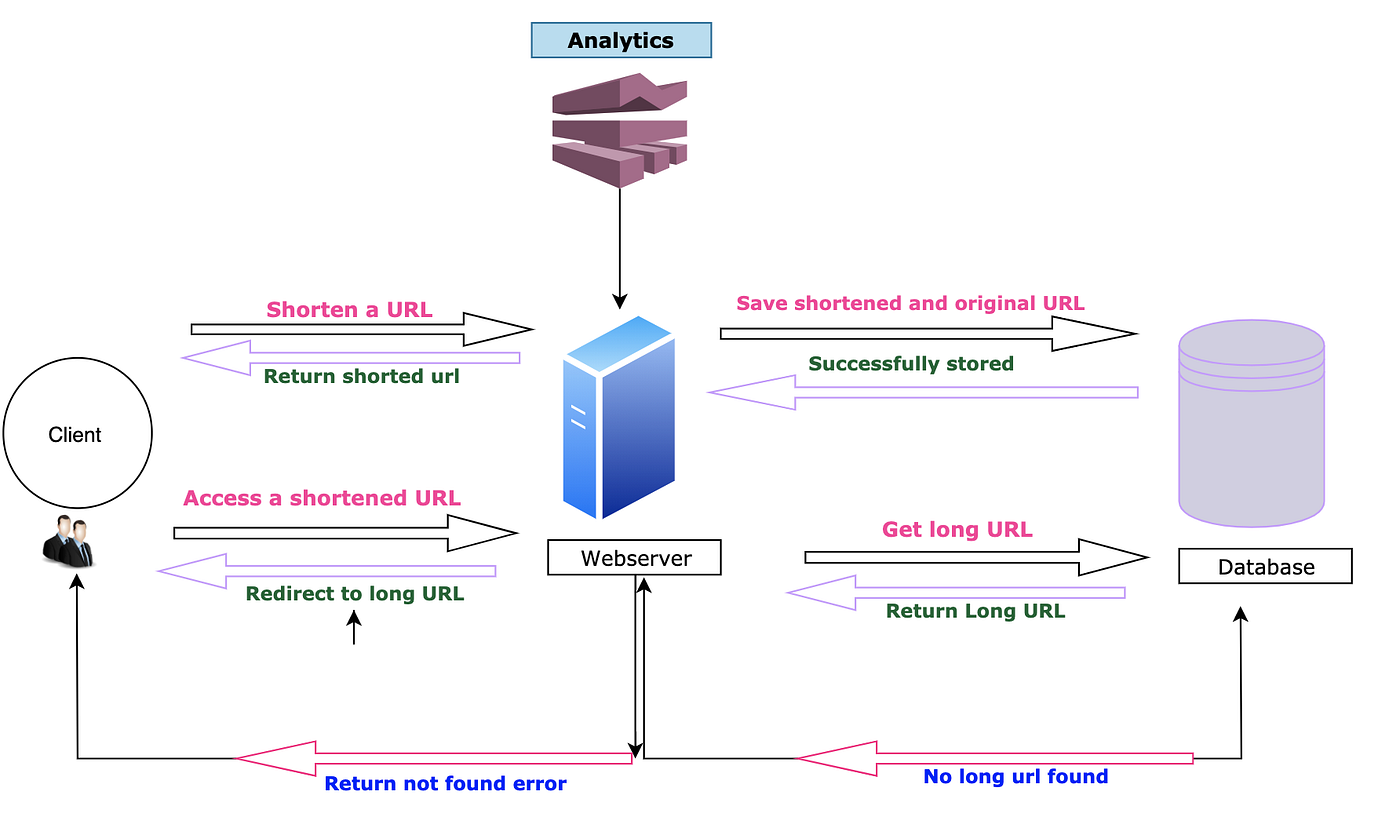
What is a URL Shortener?
URL shortener 服务会把长 URL 生成一个 alias(短链接)。用户访问短链接时会被重定向到原始 URL。
例如:
Long URL: https://karanpratapsingh.com/courses/system-design/url-shortener
Short URL: https://bit.ly/3I71d3o
Why do we need a URL shortener?
短链接更省空间,也不易输错。还可以跨设备优化链接,并支持点击追踪。
Requirements
Functional requirements
- 给定 URL,生成一个 更短且唯一 的 alias。
- 访问短链接时重定向到原 URL。
- 链接可设置过期时间(默认可永久)。
- 支持用户自定义 alias(custom short URL)。
- 返回 short link 的同时可提供 QR code / preview metadata(可选)。
Non-functional requirements
- 高 availability,低 latency。
- 系统可扩展且高效。
Extended requirements
- 防止滥用。
- 记录跳转 analytics 与 metrics。
- 黑名单/反钓鱼检测(可选)。
Estimation and Constraints
注意:和面试官确认规模假设。
Traffic
读多写少,假设 read/write = 100:1,每月生成 100M 链接。
Reads/Writes Per month
Reads:
$$ 100 \times 100 \space million = 10 \space billion/month $$
Writes:
$$ 1 \times 100 \space million = 100 \space million/month $$
Requests Per Second (RPS)
100M/月约 40 RPS:
$$ \frac{100 \space million}{(30 \space days \times 24 \space hrs \times 3600 \space seconds)} = \sim 40 \space URLs/second $$
read/write=100:1,则重定向约 4000 RPS:
$$ 100 \times 40 \space URLs/second = 4000 \space requests/second $$
Bandwidth
写入流量:
$$ 40 \times 500 \space bytes = 20 \space KB/second $$
读取流量:
$$ 4000 \space URLs/second \times 500 \space bytes = \sim 2 \space MB/second $$
Storage
存 10 年:
$$ 100 \space million \times 10\space years \times 12 \space months = 12 \space billion $$
每条 500 bytes:
$$ 12 \space billion \times 500 \space bytes = 6 \space TB $$
Cache
按 80/20 缓存 20% 热点:
$$ 4000 \space URLs/second \times 24 \space hours \times 3600 \space seconds = \sim 350 \space million \space requests/day $$
缓存约 35 GB/day:
$$ 20 \space percent \times 350 \space million \times 500 \space bytes = 35 \space GB/day $$
High-level estimate
| Type | Estimate |
|---|---|
| Writes (New URLs) | 40/s |
| Reads (Redirection) | 4K/s |
| Bandwidth (Incoming) | 20 KB/s |
| Bandwidth (Outgoing) | 2 MB/s |
| Storage (10 years) | 6 TB |
| Memory (Caching) | ~35 GB/day |
Data model design
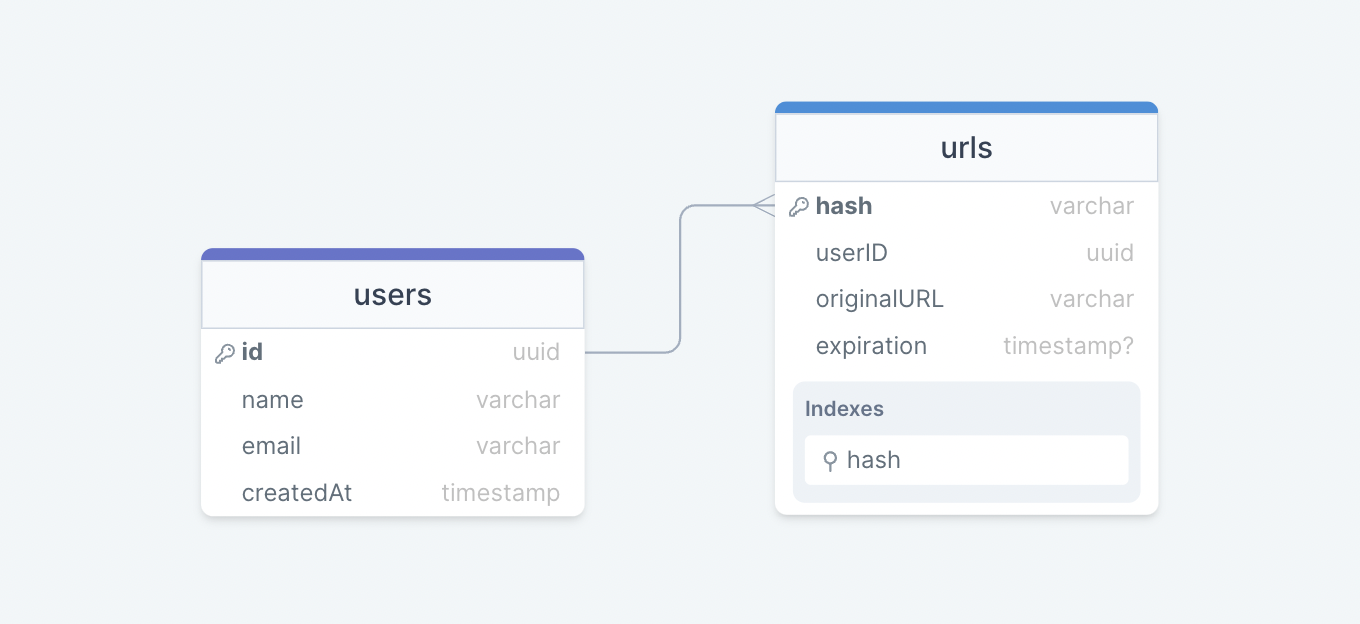
初期两张表:
users
用户信息:name、email、createdAt 等。
urls
短链接记录:expiration、hash、originalURL、userID、createdAt、isCustom。hash 可做 index 提升查询性能。
clicks (optional)
按天或按小时聚合:hash、ts_bucket、country、device、referrer、count。
选什么 database?
数据关系不强,可选 Amazon DynamoDB、Apache Cassandra、MongoDB。如需 SQL,可用 Azure SQL Database 或 Amazon RDS。
更多对比见 SQL vs NoSQL。
API design
Create URL
createURL(apiKey: string, originalURL: string, expiration?: Date, customAlias?: string): string
Get URL
getURL(apiKey: string, shortURL: string): string
Delete URL
deleteURL(apiKey: string, shortURL: string): boolean
为什么需要 API key?
用于防止滥用,限制用户 QPS/分钟请求数,是 developer API 的常见做法。
High-level design
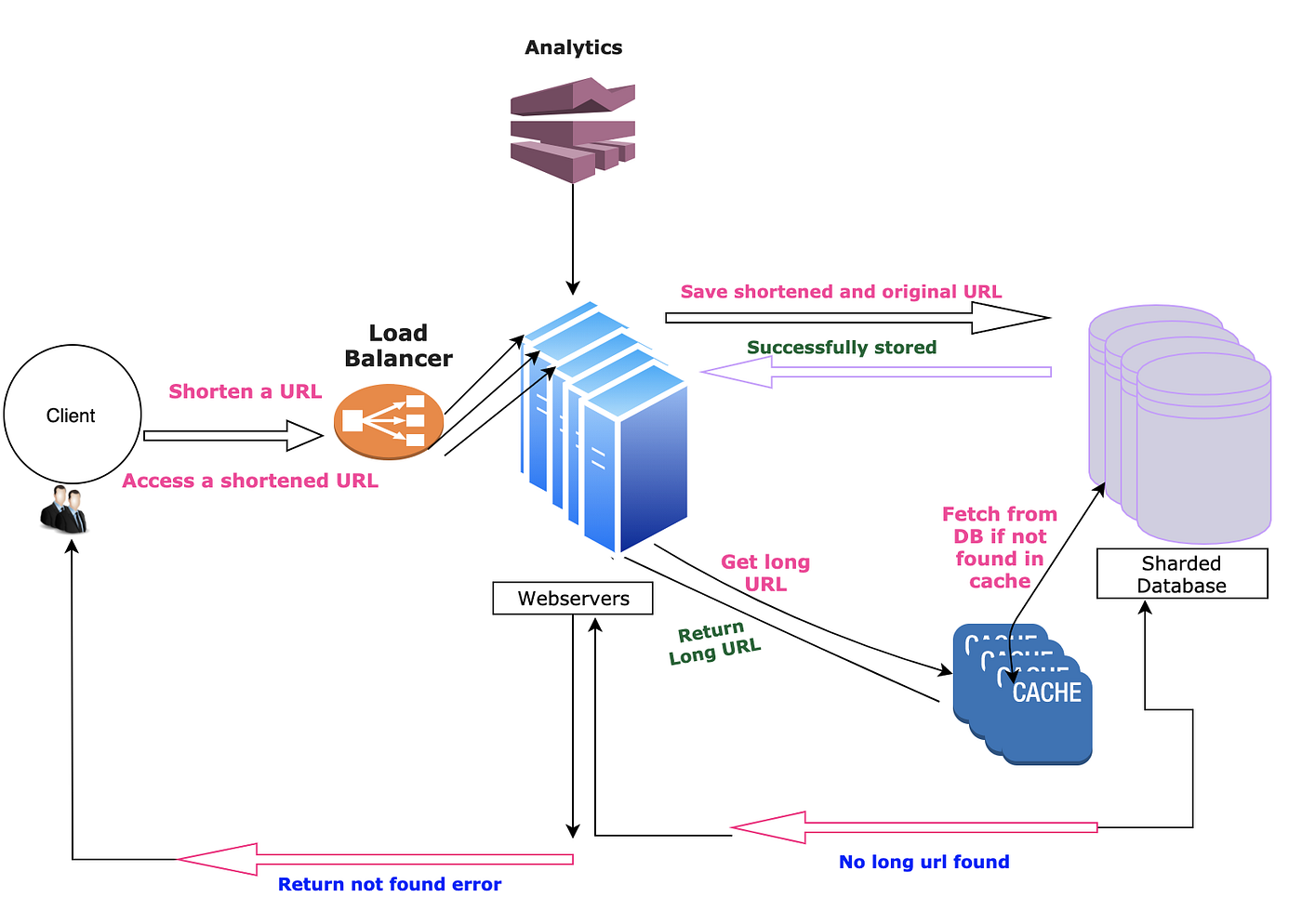
URL Encoding
Base62 Approach
用 Base62(A-Z, a-z, 0-9)编码:
$$ Number \space of \space URLs = 62^N $$
N=7 时约 3.5 trillion:
$$ \begin{gather*} 62^5 = \sim 916 \space million \space URLs \ 62^6 = \sim 56.8 \space billion \space URLs \ 62^7 = \sim 3.5 \space trillion \space URLs \end{gather*} $$
简单但无法保证唯一。
MD5 Approach
$$ MD5(original_url) \rightarrow base62encode \rightarrow hash $$
会有 collision,需重算,开销大。
Counter Approach
$$ Counter(0-3.5 \space trillion) \rightarrow base62encode \rightarrow hash $$
单点问题明显。可用 Zookeeper 分配 range:
$$ \begin{align*} & Range \space 1: \space 1 \rightarrow 1,000,000 \ & Range \space 2: \space 1,000,001 \rightarrow 2,000,000 \ & Range \space 3: \space 2,000,001 \rightarrow 3,000,000 \ & ... \end{align*} $$
Key Generation Service (KGS)
独立 KGS 预生成 keys 存储。用两张表 + locking 处理并发,热点 keys 可缓存内存。
KGS database estimations
6 位 key 约 56.8B,存储 ~390GB:
$$ 6 \space characters \times 56.8 \space billion = \sim 390 \space GB $$
Caching
Design
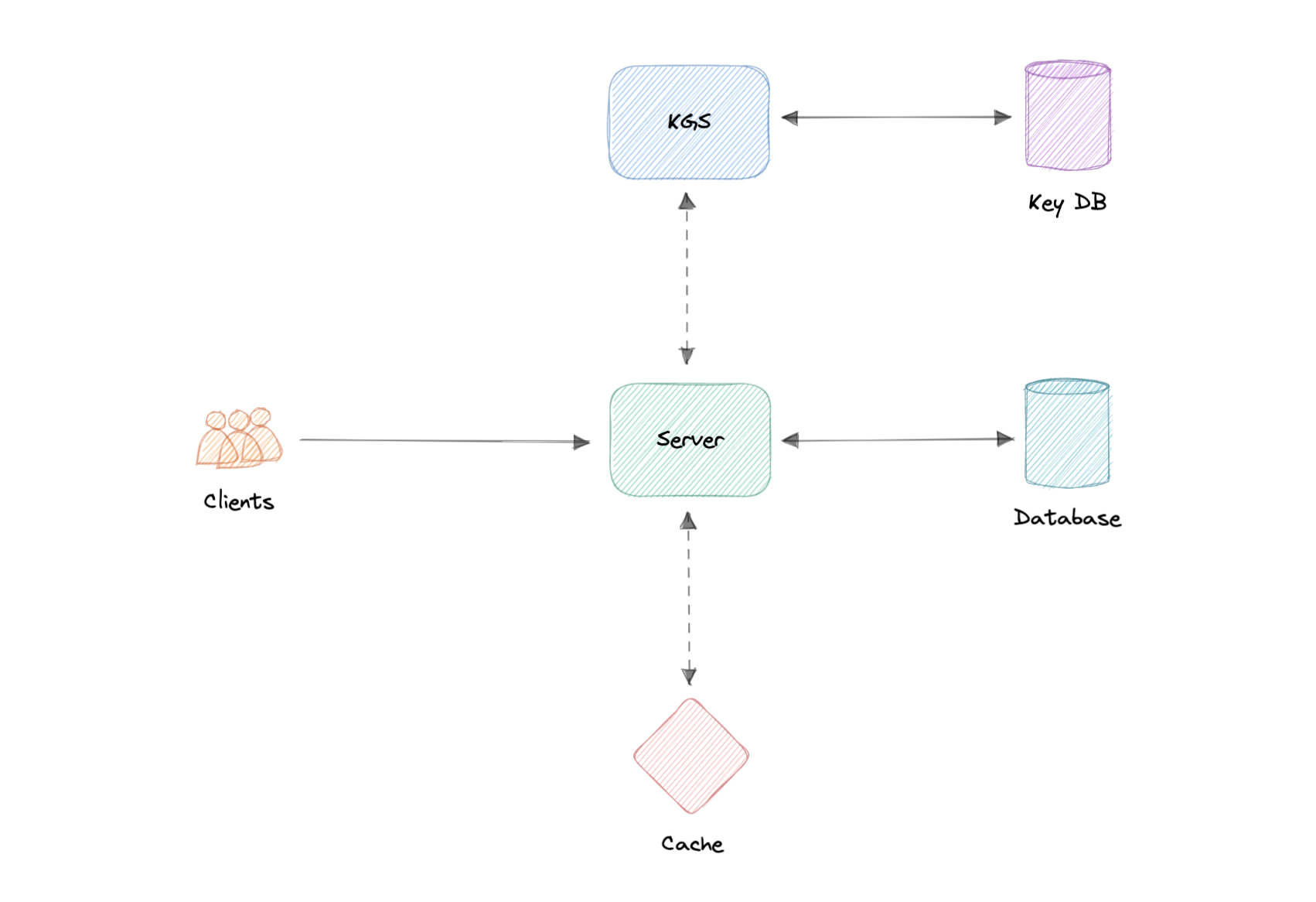
Create URL
- API server 向 KGS 请求 key。
- KGS 返回 key 并标记已用。
- API server 写 DB + cache。
- 返回 HTTP 201。
Access URL
- 请求进 API server。
- 命中 cache 返回 302(方便做 analytics);未命中则查 DB 再 cache。
- DB 无结果返回 404。
Detailed design
Data Partitioning
用 Sharding + Consistent Hashing 解决分布不均。
Database cleanup
Active cleanup:定期 cron 清理过期。
Passive cleanup:访问时发现过期再清除。
Custom alias
允许用户提供自定义 alias(例如长度 <= 16)。为了隔离写入负载,可把 custom URLs 放在单独的 DB / table。路由时先查 custom bucket,再查系统生成 bucket。
Redirect status (301 vs 302)
- 301:更 cache-friendly,但浏览器/中间缓存会减少你拿到的 click data。
- 302:每次都会打到 backend,更适合实时 analytics。
Cache
Eviction:LRU。
Cache miss:回源 DB,再更新 cache。
Metrics and Analytics
记录地区、平台、views 等。常见做法是把 redirect 事件写入 queue(Kafka / Pub/Sub),离线聚合统计。
Security
支持 private URLs + 授权表;不符合权限返回 401。可用 API Gateway 支持 auth / rate limit / load balancing。
Load balancer placement
- Client → App servers
- App servers → DB
- App servers → Cache
基础可以用 round-robin;更高级可按 latency / load 自适应。
Identify and resolve bottlenecks
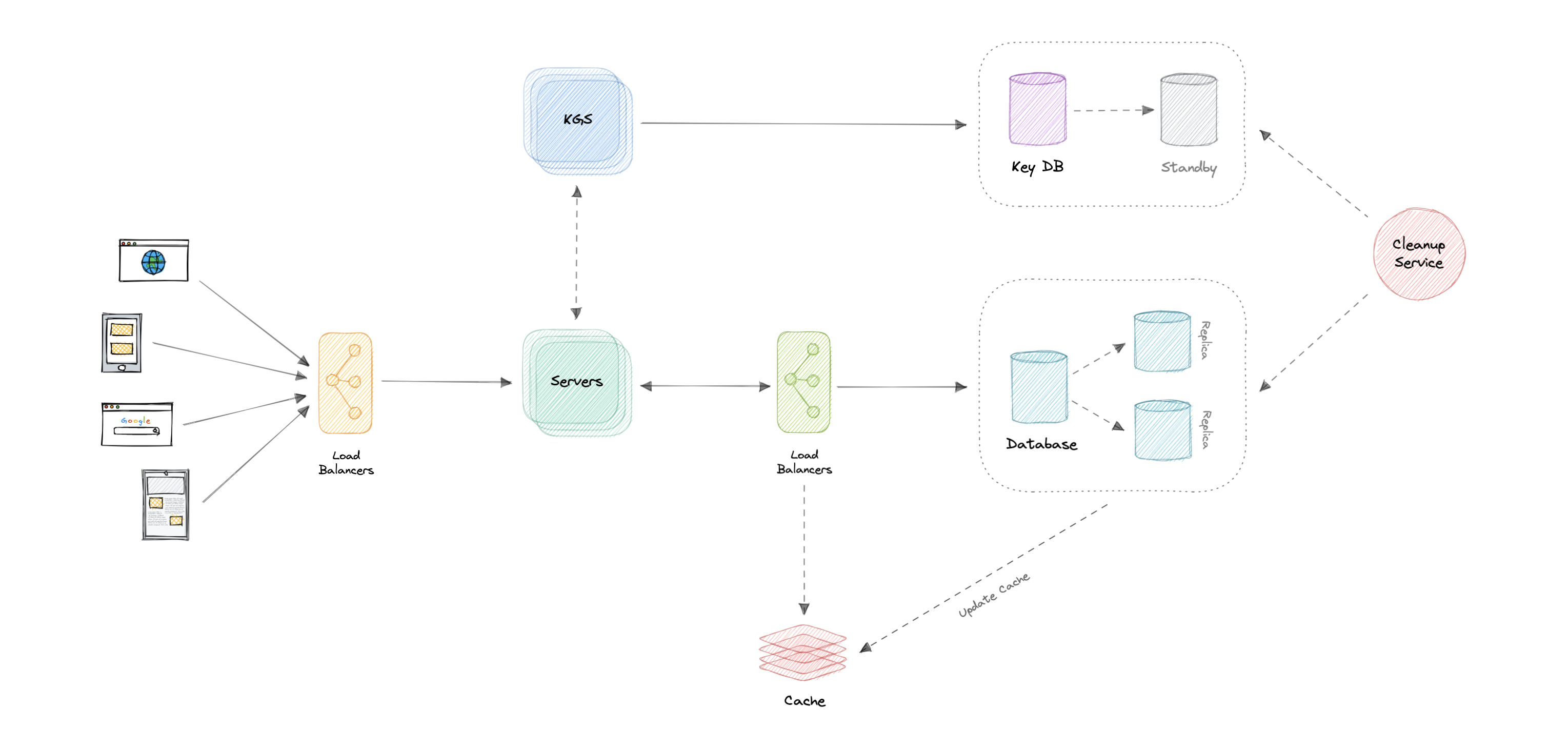
提升 resilience:
- 多实例 API 与 KGS
- Load balancers
- DB read replicas
- KGS key DB standby
- 分布式 cache 多副本